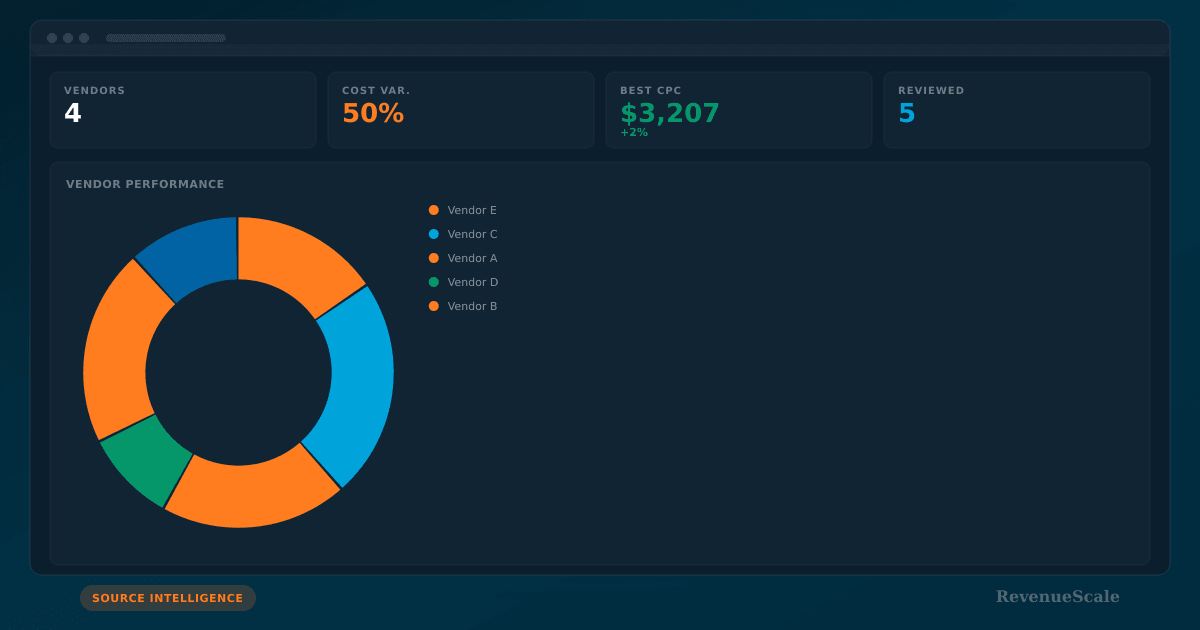
For personal injury law firms, lead generation isn't just an expense; it's the lifeblood of growth. You invest heavily in Google Ads, Facebook, TV, radio, and lead aggregators, expecting a clear return: signed cases. Yet, for many marketing directors, the question of whether each vendor truly delivers remains shrouded in uncertainty. Vendor-provided reports often paint a rosy picture, focusing on cost per lead (CPL) and impressions, while the true cost—the cost per signed case—remains a mystery.
This gap between reported metrics and real outcomes creates hidden waste and underperformance. Without an independent, data-driven audit process, you're forced to make budget decisions based on gut instinct or incomplete data. The result? Valuable marketing dollars are left on the table, underperforming vendors continue to drain resources, and your firm misses out on the 15-20% marketing ROI increase that proactive optimization can deliver.
At RevenueScale, we believe cost per case is the only metric that matters. This guide will walk you through how to implement a comprehensive lead vendor audit for your PI firm, transforming your marketing investment from a black box into a predictable revenue engine.
The Illusion of Efficiency: Why Vendor Reports Fall Short
Every lead vendor has a vested interest in making their performance look good. They deliver reports filled with impressive CPLs, click-through rates, and impression volumes. But these numbers are often vanity metrics that fail to connect spend to what truly matters: signed cases and ultimately, settlement revenue.
The core issue is attribution. Most PI firms still track marketing ROI manually in spreadsheets, or rely on their CRM's default last-touch attribution. This leaves massive gaps. A lead from a TV commercial might search Google a week later and convert via a paid search ad. Without proper, multi-touch attribution, Google gets all the credit, and your TV spend looks inefficient. When you multiply this problem across 5+ vendors and hundreds of leads per month, the “true” cost per case becomes impossible to discern from vendor data alone.
You need an independent system that unifies all your data—marketing spend, lead volume, intake performance, and case outcomes—to expose the full story.
| Traditional Review (Spreadsheet) | Revenue Intelligence Audit | |
|---|---|---|
| Primary Metric | Cost Per Lead (CPL) | Cost Per Case (CPC) |
| Data Sources | Vendor Reports, CRM lead count | CRM, Ad Platforms, Call Tracking, Invoices |
| Attribution Model | Last-touch (often), or none | Multi-touch, settlement-level |
| Frequency | Monthly/Quarterly | Continuous, real-time alerts |
| Insight Level | What happened? | Why it happened & what to do next |
| Actionability | Low (guesswork) | High (data-backed decisions) |
| Time Spent on Reporting | 15+ hours/week | 15 minutes/week |
A side-by-side look at how Revenue Intelligence transforms vendor accountability.
Phase 1: Build Your Single Source of Truth (Data Integration)
The first step to a truly effective vendor audit is centralizing your data. Most PI firms operate with fragmented data across multiple platforms: lead aggregators send spreadsheets, Google Ads has its own dashboard, Facebook has another, call tracking lives in CallRail, and signed cases are in your CRM. Reconciling these manually is not only time-consuming (often 15+ hours/week for marketing directors) but also prone to errors and inconsistencies.
A Revenue Intelligence platform acts as your single source of truth, integrating directly with your:
- **Case Management System (CMS):** LeadDocket, Salesforce, Filevine, Clio, MyCase. This is where signed case data and settlement amounts live.
- **Advertising Platforms:** Google Ads, Facebook/Meta Ads, TikTok, LinkedIn. These provide your spend data and top-of-funnel metrics.
- **Call Tracking Platforms:** CallRail, CallTrackingMetrics. Crucial for attributing inbound calls to the correct marketing source.
- **Invoice Data:** The actual cost of your leads and media buys.
Connecting these systems creates a unified dataset where every lead, every dollar spent, and every signed case is linked. This foundational layer of Source Intelligenceis what enables accurate cost per case calculations. It means moving from disparate reports to one cohesive view, freeing up your team from endless data reconciliation.
Phase 2: Define Your Performance Metrics (Beyond Cost Per Lead)
Once your data is integrated, the next step is to redefine what “performance” means for each vendor. Stop optimizing solely for CPL. It's a distraction that hides deeper inefficiencies. Instead, focus on a comprehensive set of metrics that genuinely reflect a vendor's value to your firm:
- **Cost Per Signed Case (CPC):** The ultimate metric. This tells you the true cost to acquire a retained client from a specific vendor. It accounts for both marketing spend and intake efficiency.
- **Contact Rate by Source:** The percentage of leads from a given vendor that your intake team actually connects with. A low contact rate often signals poor lead quality, even if the CPL seems good.
- **Rejection Rate by Source:** The percentage of contacted leads that don't meet your firm's qualification criteria. High rejection rates from a vendor mean you're paying for leads that were never viable.
- **Withdrawal Rate by Source:** The percentage of signed cases that later withdraw. Some vendors deliver cases that appear signed but are unstable, leading to wasted intake and attorney time.
- **Time to Sign by Source:** How quickly leads from a specific vendor convert from initial contact to a signed retainer. Faster “time to sign” indicates higher intent and more efficient intake.
- **Average Settlement Value by Source:** The most advanced metric, directly connecting vendor performance to actual revenue. This allows you to evaluate vendors not just on quantity, but on the quality and value of the cases they deliver.
These metrics provide a holistic view that no single vendor report can offer. They empower your marketing director, like “Data-Driven Dan,” to understand the true economics of each lead source.
Your 4-Step Lead Vendor Audit Process
Implementing a data-driven vendor audit doesn't require overhauling your entire operation overnight. It's a systematic process that builds on itself, yielding compounding returns. Here's how RevenueScale empowers PI firms to conduct a thorough audit, moving from data collection to actionable intelligence.
Step 1: Unify Your Data Foundation
Integrate your CRM, ad platforms, call tracking, and invoice data into a single source of truth, linking every lead to its original source.
Step 2: Calculate True Cost Per Case by Vendor
Move beyond misleading CPLs to understand the actual cost (marketing spend + intake labor) for every signed case from each lead source.
Step 3: Analyze Beyond Acquisition: Quality & Velocity
Evaluate comprehensive metrics like contact rates, rejection rates, time to sign, and average settlement value to grade true vendor performance.
Step 4: Act: Reallocate, Optimize, Negotiate
Use clear data to shift budget from underperforming vendors, scale up high-ROI channels, and negotiate better terms with every partner.
From data silos to strategic vendor optimization in four clear steps.
Phase 3: Turn Insights into Action (Optimization & Negotiation)
With your data unified and your metrics defined, the real work—and the real value—begins. A Revenue Intelligence audit isn't just about identifying problems; it's about creating a clear path to action.
**Identifying Underperformers:** Your centralized dashboard will immediately highlight vendors with high cost per case, low contact rates, or high rejection/withdrawal rates. These are your opportunities for improvement. You might discover that a vendor with a great CPL is delivering cases that cost three times as much to actually sign and settle, due to poor lead quality or high attrition.
**Reallocating Budget:** Armed with concrete cost per case data, you can confidently shift budget away from underperforming channels and towards those with proven ROI. This isn't about cutting blindly; it's about strategic reallocation that maximizes your overall marketing efficiency. This strategic shift is a primary driver of the 15-20% marketing ROI increase RevenueScale clients typically see within 90 days.
**Negotiating Better Terms:** When you sit down with a lead vendor, you're no longer relying on their reports. You have your own verified data on their contact rate, rejection rate, and true cost per case. This empowers you to negotiate credits for unqualified leads, demand improved targeting, or secure better pricing tiers based on proven performance. This level of data-driven negotiation is how you move from a reactive relationship to a truly strategic partnership.
For a deeper dive into how our platform empowers these decisions, explore our Marketing ROI solutions.
Stop Guessing. Start Growing.
In the competitive world of personal injury law, every marketing dollar must work as hard as possible. Relying on partial data or vendor-provided reports is a recipe for hidden waste and missed opportunities. By implementing a systematic lead vendor audit powered by Revenue Intelligence, your PI firm can uncover true performance, eliminate underperforming spend, and scale the channels that deliver real, profitable cases.
Ready to take control of your marketing budget and achieve a measurable increase in your firm's ROI?