The conversation happens in every PI firm eventually. Signed case numbers disappoint. The managing partner asks why. Marketing says the leads were poor quality — wrong case types, bad contact information, too much competition. Intake says marketing is sending low-intent prospects who were never serious about retaining an attorney.
Both sides believe they're right. Neither side has proof. So the firm keeps spending money on the same lead sources, the intake team keeps processing the same mix of leads, and the conversion rate stays stuck.
There is a way to resolve this argument that does not involve gut instinct or blame. It requires three specific metrics pulled from your intake CRM, segmented by lead source. Once you have those numbers, the diagnosis is usually clear within 20 minutes. The fix — whether it is cutting a vendor, retraining intake, or doing both — follows directly from what the data shows.
Why This Distinction Is a Budget Decision, Not Just a Process One
The reason this question matters goes beyond team morale. The answer determines where you spend money next month.
If your conversion problem is lead quality, the fix is at the source: cut the underperforming vendor, reduce their allocation, or renegotiate terms. Spending more on intake training, additional headcount, or faster follow-up software will not help if the leads themselves lack merit. You'll just convert bad leads faster.
If your conversion problem is intake performance, the fix is internal: speed-to-lead, after-hours coverage, intake specialist coaching, or scripting improvements. Cutting a vendor with genuinely good leads because your team's conversion rate looks low will just cost you cases you should have been signing.
These are opposite interventions. Getting the diagnosis wrong is expensive in either direction.
The Three Metrics That Separate Lead Quality From Intake Performance
Most PI firms track a blended conversion rate: total signed cases divided by total leads. That number is nearly useless for diagnosis. It mixes lead quality signals with intake performance signals into a single figure that cannot be acted on.
Pull the following three metrics by lead source for the past 90 days. You need source-level data, not firm-level data, to make the diagnosis.
Contact rate by source.This is the percentage of leads from each source that intake successfully reached for a qualifying conversation — not left a voicemail, not sent a text, but actually spoke with. A lead that intake never contacts is invisible in your conversion denominator but still appears in your lead cost calculation. Contact rate differences between sources often reveal lead quality problems at the point of generation (bad phone numbers, form submissions with no intent to connect), not intake failures.
Rejection rate by source.This is the percentage of leads that intake contacted and screened but determined did not meet case criteria — wrong case type, wrong jurisdiction, statute of limitations, no viable injury claim. A high rejection rate from a specific vendor is a case quality signal, not an intake performance signal. Intake rejected those leads correctly; the problem is that the vendor sent them.
Net conversion rate by source. This is the percentage of qualifiedleads — leads intake contacted and approved — that ultimately signed retainers. This is the number that reflects your intake team's actual selling and follow-through performance. If net conversion rate is low across all sources, the problem is intake. If it is high on most sources but low on a specific vendor, the problem is that vendor's lead definition of “qualified.”
Healthy Net Conversion Rate
25–35%
Top-performing PI intake teams convert 25–35% of qualified contacts to signed retainers. Below 18% across all sources signals an intake process issue.
Expected Rejection Rate Range
8–30%
Rejection rates below 10% suggest intake may be signing unviable cases. Above 30% on any single source points to a lead quality problem with that vendor.
Contact Rate Variance by Source
Up to 40 pts
Contact rates can vary by 30–40 percentage points across lead sources. A source with a sub-45% contact rate has a structural quality problem, not an intake timing problem.
Running the Diagnosis: What to Pull From Your CRM
Open your intake CRM — LeadDocket, Salesforce, HubSpot, Filevine, Clio, or whatever system your intake team logs calls in — and pull the following for the past 90 days, filtered by lead source.
For each source: total leads received, leads with a logged contact attempt, leads where contact was confirmed (a live conversation occurred), leads rejected during screening, leads that passed screening, and leads that became signed retainers. Calculate contact rate (confirmed contacts ÷ total leads), rejection rate (rejections ÷ confirmed contacts), and net conversion rate (signed ÷ passed screening).
Run this calculation for every source that has generated at least 25 leads in the 90-day window. Sources with fewer than 25 leads have too little data to produce reliable rates. Aggregate smaller sources by type (shared aggregators, exclusive leads, referrals, paid search) if individual vendor volume is too thin.
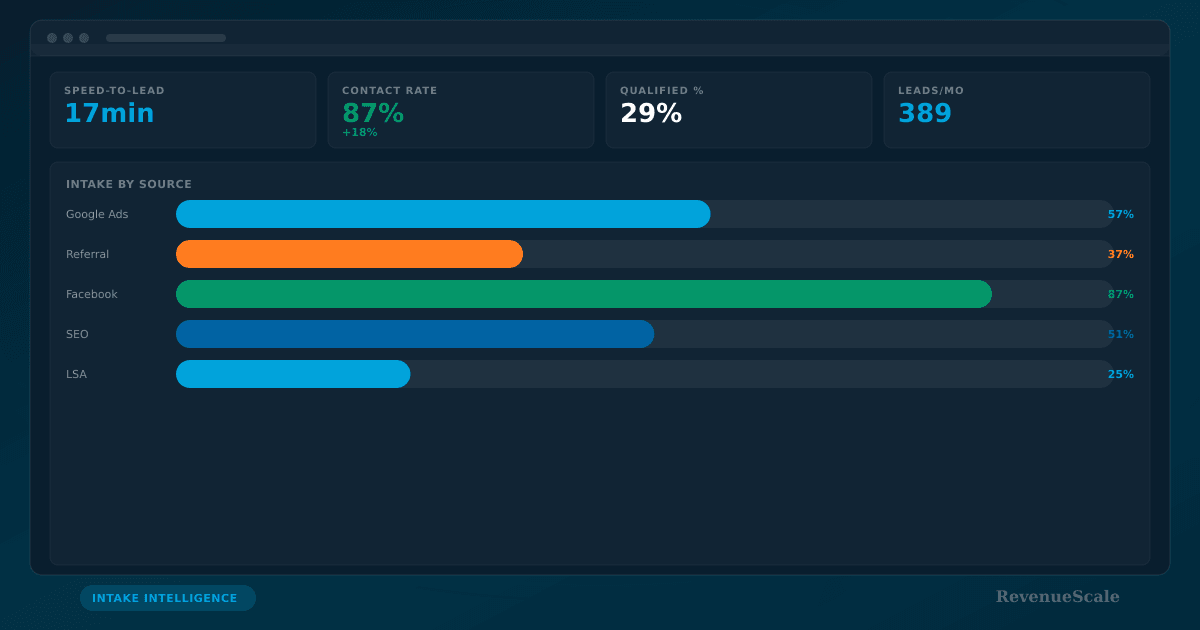
Representative contact rate benchmarks by source type. Your firm's rates will vary based on market, intake team structure, and response time. Use these as directional benchmarks, not exact targets.
Reading the Pattern: What the Data Is Telling You
Once you have contact rate, rejection rate, and net conversion rate by source, the pattern usually points clearly in one direction.
If contact rate is uniformly low across all sources— say, below 50% even for referrals and Google Ads, which typically run 60 to 80% — the problem is almost certainly intake coverage. After-hours gaps, slow first response, or insufficient staffing during peak lead-arrival windows create a systemic contact rate drag that affects good and bad leads equally. No vendor optimization fixes this. Intake process does.
If contact rate is low for specific vendors only— you reach 65% of Google leads and 38% of a specific aggregator's leads with identical intake response times — the problem is that vendor. They are sending leads with bad contact information, abandoned intent, or auto-generated form fills. The intake team is not missing those calls; the leads are not real.
If rejection rate spikes on specific vendors while remaining normal on others, those vendors are misrepresenting their lead criteria or have drifted in the types of cases they are generating. Intake is doing its job by rejecting them. The fix is a vendor conversation, not a training session.
If net conversion rate is low across all sources— after controlling for contact and rejection — that is where intake process enters the picture. It means intake specialists are reaching and screening leads but not consistently closing retainers. This is where intake training, scripting, follow-up cadence, and specialist coaching become the right investment.
Without Source-Level Diagnostic Data
- Blended conversion rate of 8% leads to general frustration with “the leads”
- Marketing and intake argue without data to support either position
- Managing partner considers cutting entire lead generation budget or replacing intake staff
- No distinction between vendors sending uncontactable leads and vendors sending bad cases
- Intake team demoralized by blame for conversion numbers they cannot control
- Budget decision made based on instinct rather than source-level evidence
With Source-Level Diagnostic Data
- Contact rate report shows Vendor B has 38% contact rate vs. 63% firm average
- Rejection rate report shows Vendor C sends 34% non-qualifying cases vs. 12% average
- Net conversion rate is 28% across all other sources — intake performance is not the issue
- Managing partner has specific, vendor-attributed evidence to support the budget conversation
- Intake team's high performance on referral and Google leads is visible and credited
- Budget reallocated from Vendors B and C to sources where intake converts at 28%
What to Do With Your Findings
The diagnosis produces one of three action paths, and occasionally a combination.
Vendor problem: If specific sources show low contact rates or high rejection rates, start by reviewing the issue with the vendor directly. Bring the contact rate data to the conversation. Most lead vendors have performance standards in their contracts that allow for credit or replacement when quality falls below agreed thresholds. If the vendor cannot or will not address the problem, reduce their allocation or cut them. Redirect that budget to sources where your contact and net conversion rates are healthy.
Intake problem:If net conversion rate is low across all sources, the investment belongs in intake. That might mean faster follow-up protocols, after-hours coverage, intake specialist coaching using call recordings, revised scripting for specific case types, or additional headcount during peak volume windows. Revisit the speed-to-lead data — response time under five minutes is the single most impactful intake process lever.
Both problems: Occasionally the diagnosis reveals a vendor issue and an intake gap. Triage by impact. Cutting the bad vendor first stops the bleeding. Fixing intake after that amplifies the improvement on the remaining good-quality lead sources.
Either way, the decision is grounded in data your firm already has. It just needs to be assembled by source rather than blended into a single firm-level number that obscures everything that matters.
Making This Analysis a Monthly Habit
The diagnosis described above should not be a one-time exercise. Lead quality drifts. Vendors rotate their lead generation methods. Intake team composition changes. A vendor who had a 65% contact rate six months ago may be at 44% today because they changed their traffic sources or lead qualification process.
Build the three-metric review — contact rate, rejection rate, and net conversion rate by source — into your monthly lead vendor review. It adds 20 minutes to a meeting that typically covers surface- level lead volume and cost-per-lead data that cannot answer the question your managing partner is actually asking.
When intake conversion data is connected to your intake performance dashboard alongside your source-level marketing attribution, this analysis runs automatically rather than requiring manual CRM queries each month. You see contact rate, rejection rate, and net conversion rate by source in a single view — updated continuously as leads flow through intake.
If you want to see what that view looks like for a firm managing five or more lead sources, book a demo. We'll show you how to separate lead quality from intake performance in your own data — and what the budget decisions look like once the distinction is clear.