Walk into most PI marketing directors' offices and ask what their email programs cost per signed case. You will get one of three answers: a confused look, a list of open rates and click rates, or an honest “we've never measured that.” Email is the one marketing channel most PI firms run but almost none measure to a signed retainer.
That gap matters more than it looks. Email is not a primary acquisition channel for PI firms—you are not cold-emailing strangers hoping they were just in an accident. But it is where lead remarketing, past-client referral activation, and attorney referral nurture happen. When those programs work, they generate cases at a fraction of what Google Ads or aggregator leads cost. When they go unmeasured, the cases they generate get misattributed to direct traffic, branded search, or organic—which makes those channels look more efficient than they are while email looks like it produces nothing.
This guide covers how to set up email attribution for a PI firm, what cost per case by email program type actually looks like, and how to put email on the same dashboard as every other source you manage.
PI Firms Tracking Email to Signed Cases
~11%
Most PI email users report open rates and click rates — not signed retainers. The measurement gap is nearly universal.
Lead Remarketing Sequence Conversion Rate
15–25%
PI firms with structured email remarketing convert 15–25% of engaged unconverted leads who received 3+ touchpoints.
Estimated Cost Per Case: Email Remarketing
$300–$900
Remarketing email converts leads already in the CRM — the cost per attributed case reflects platform cost, not re-acquisition cost.
Why Email Works Differently in PI Than in Other Industries
In most industries, email is a primary acquisition channel—you build a list, nurture it, and convert subscribers to buyers. PI does not work that way. Nobody subscribes to a personal injury newsletter hoping to eventually get hurt.
In PI, email plays four roles, each generating cases through a different mechanism:
- Lead remarketing sequences:Automated follow-up to leads who contacted the firm but did not sign within the first few days. These are people who already raised their hand—email is what keeps your firm top-of-mind until they decide.
- Past-client referral activation:Communication to former clients asking them to refer friends and family. One email to 400 past clients can generate two or three referral cases—each of which cost essentially nothing to acquire.
- Attorney and medical referral partner nurturing: Monthly or quarterly emails to referring attorneys, chiropractors, and orthopedic clinics that keep your firm relevant when a referral opportunity arises. Firms maintaining active referral partner email programs consistently see 15–20% higher referral volume than firms relying on relationships alone.
- Intake pipeline follow-up:Automated touchpoints to leads still in the qualification process—not-yet-signed cases who need one more reason to commit.
Every one of these programs can generate signed cases. None of them produces clean attribution without deliberate setup.
The Core Attribution Problem with Email
When a Google Ads prospect clicks your ad and calls your tracking number, attribution is automatic. When a lead from six weeks ago receives your remarketing email, clicks a link, revisits your site, and calls your main intake number—email gets zero credit in your default reporting. The case lands in “direct traffic” or “branded search” and disappears from your email performance data.
Closing that gap requires three things working together: UTM parameters on every email link so clicks are identifiable in your analytics, a CRM lead source tag that survives from email click to signed case, and structured intake questioning that captures the phone calls email generates but cannot automatically attribute.
Missing any one of these three components means email cases systematically leak into other source buckets—making email look unproductive and making direct traffic, organic, and branded search look more efficient than they actually are.
Method 1: UTM Tagging and CRM Lead Source Integration
Every link in every email you send should carry UTM parameters that identify the source, medium, and specific campaign. The standard structure for PI email programs:
- utm_source: email
- utm_medium: remarketing, referral-nurture, past-client, or intake-followup (match your program type)
- utm_campaign:specific campaign name and date (e.g., “lead-nurture-april-2026”)
When a prospect clicks and completes a web form, the UTM data should auto-populate a hidden “lead source” field in your CRM if your form is connected to your analytics platform. That tag then flows through to the case record when the lead signs.
The challenge is the phone call. A prospect who clicks your email, reads your page, and then dials your intake line does not carry UTM data into the call. That is where intake questioning closes the loop.
Method 2: Structured Intake Questioning
Phone calls triggered by email are invisible in digital analytics. The only way to capture them is to ask. Your intake source question must include specific email-related options—not a free-text field, but a forced-choice dropdown with:
- Received an email or follow-up from this firm
- Past client—referred by someone we worked with
- Attorney or doctor referral
Train every intake specialist to ask the source question on every call, every time. One PI firm that added a specific “email follow-up” option to their intake source dropdown recovered 11 email-attributed cases in the first 30 days that had previously been tagged as “unknown source.” At an average case value of $28,000 in attorney fees, that was attribution clarity on $308,000 in projected fee revenue.
Method 3: List Reconciliation for Referral Partner Programs
Attorney referral and medical referral email programs do not produce a direct click-to-signed-case path. A referring chiropractor who receives your quarterly newsletter may send a patient to your firm three months later—the email influenced the referral, but no UTM parameter will tell you that.
Monthly list reconciliation approximates attribution for these programs:
- Pull every new lead tagged as an attorney or medical referral source during the month.
- Cross-reference the referring party against your email list of referral partners who received communication in the last 90 days.
- Flag referrals from active email contacts as “email-assisted referral” in your reporting. This is channel-level attribution, not case-level attribution—but it is better than assuming email had no role.
This method will not tell you precisely which email generated which referral. It will tell you whether referral partners who receive regular email communication refer more cases than those who do not. That pattern, measured over six months, usually makes a compelling case for the email program budget.
Tag Every Email Link with UTM Parameters
Add utm_source=email, utm_medium matching your program type, and a specific utm_campaign name to every link in every email. Connect your web forms to your CRM so UTM data auto-populates the lead source field on contact. Never send a campaign email without UTM parameters — untagged links make attribution impossible.
Add Email-Specific Options to Your Intake Source Dropdown
Create dedicated intake source options for email-driven leads: received email follow-up, past client referral, and attorney or medical referral. These options capture the phone calls that UTM tracking cannot. Train every intake specialist to ask the source question on every call and verify tagging consistency in weekly QA reviews.
Run Monthly Attribution Reconciliation by Email Program
Each month, pull cases tagged to email sources from your CRM and divide by your total email marketing cost for the period. Run the calculation separately for each program type — remarketing, past-client referrals, and referral partner nurture. Cross-reference referral cases against your email contact list to identify email-assisted referrals. Use this data to compare email cost per case against your other channels.
What Cost Per Case from Email Actually Looks Like
Email marketing costs for PI firms fall into two buckets: the platform cost (email service provider subscription, typically $200–$1,200 per month depending on list size and features) and content cost (who writes and manages the campaigns—staff time or agency).
Once you have attribution in place, cost per case by email program type tells a very different story than most firms expect. Remarketing email converts leads you already paid $200–$600 each to generate, so the incremental cost per signed case is low. Past-client referral email activates relationships you built over years of case work at near-zero marginal cost. The numbers below reflect firms with 90 or more days of email attribution data and active programs in each category.
Based on PI firms with full email attribution over 90+ days. Cost reflects email platform and content cost divided by attributed signed cases — not the full case acquisition cost from prior lead spend.
How Email Compares to Your Other Lead Sources
Email is not competing with Google Ads for the same impression. It operates on different economics because it leverages assets the firm already owns: unconverted leads in the CRM, settled-case client lists, and referral partner relationships built over years.
When you measure it correctly, email typically ranks as the lowest-cost channel in a PI firm's portfolio—not because it generates the highest volume, but because it converts leads and relationships that would otherwise sit idle. The cost is marginal. The cases are incremental. The ROI arithmetic is compelling.
The practical implication: if your firm is spending $30,000 per month on aggregator leads at $2,800 per case and $400 per month on email marketing at $500 per attributed case, the question is not whether to run email. The question is whether you are running enough of it—and whether you have the attribution setup to know what it is actually producing.
Most PI firms are underinvesting in email relative to its return because they cannot see the return. That is an attribution problem, not a channel problem. Once you fix the measurement, the investment decision usually takes care of itself.
Getting the Attribution Set Up in Under a Week
You do not need a new platform or a technical overhaul to start measuring email accurately. If you are already using an email service provider with UTM support—Mailchimp, ActiveCampaign, HubSpot, or any major platform—UTM tagging takes one afternoon to configure at the campaign level.
Adding the intake source question options takes one conversation with your intake team lead and one field update in your CRM. The monthly reconciliation becomes a 20-minute process once you have a clean attribution template.
Run the setup, collect 60 days of data, and pull your first email cost per case calculation. The number will probably be lower than you expect. That is typically the moment PI marketing leaders decide to actually invest in their email programs—because they can see what those programs produce for the first time.
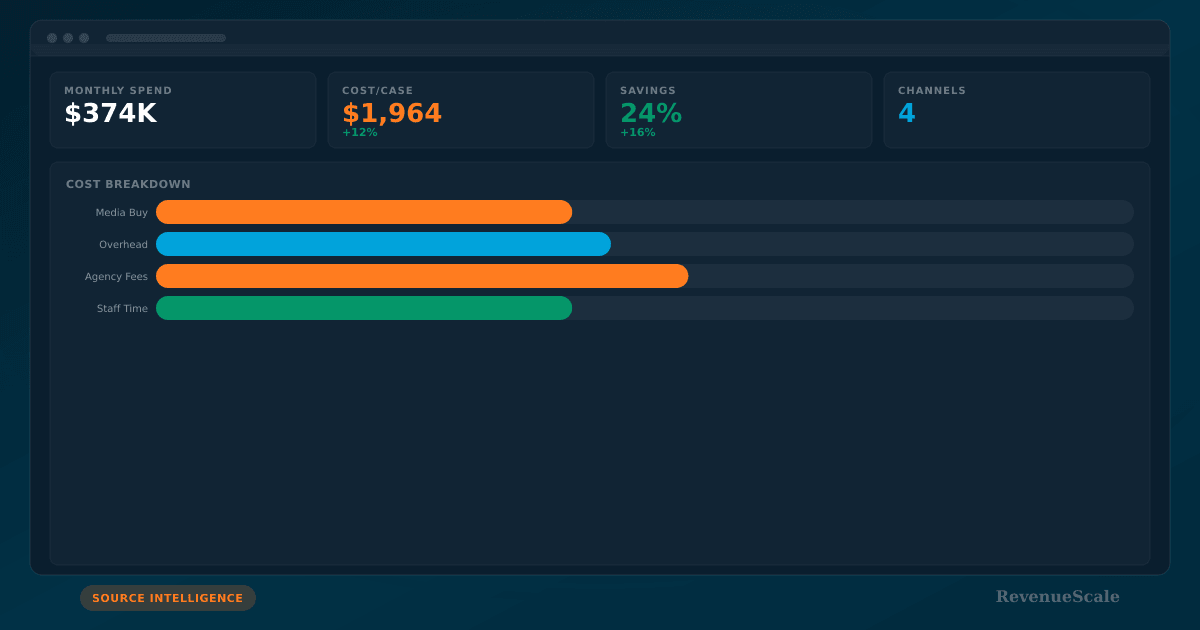
RevenueScale's Source Intelligence layerpulls every channel into a single cost-per-case view, including email programs. If you want to see what a complete channel-level attribution view looks like for your firm—with email, radio, digital, and every other source on the same dashboard—book a demo and we will walk you through how the data comes together.