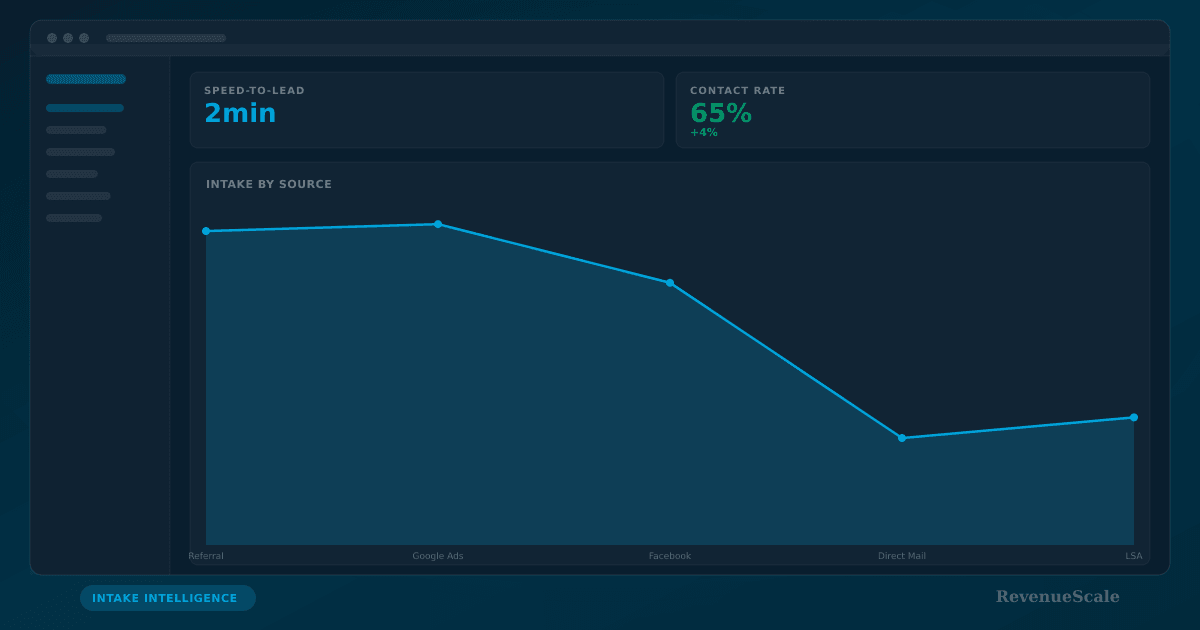
Speed-to-lead is critical, but it's only one piece of the intake puzzle. To maximize case signings, PI firms need a dynamic intake strategy that adapts to the unique characteristics of each lead source. Treating every lead the same—whether it came from a high-intent Google search or a passive Facebook ad—leaves signed cases on the table.
Most Personal Injury (PI) law firms understand the urgency of speed-to-lead. Contacting a prospect within minutes drastically increases the likelihood of conversion. But what happens after that initial contact? A "one-size-fits-all" intake process, while efficient for some lead types, can actively harm conversion rates for others. The truth is, different lead sources come with varying levels of intent, information, and expectations. An intake process that fails to recognize these nuances is missing a huge opportunity to optimize.
RevenueScale helps PI marketing directors move from spreadsheets to systems, tracking cost per case across all lead vendors so they can cut waste, scale winners, and prove ROI to partners. Part of that means understanding that the path from "lead" to "signed case" isn't a single highway—it's a network of different roads, each requiring a slightly different vehicle and driver approach.
The Problem with a "Blended" Intake Approach
When intake managers focus solely on a blended conversion rate across all leads, they miss critical signals about source-specific performance. A high-intent referral from a trusted attorney requires a different conversation than a prospect who clicked a Facebook Lead Ad at 2 AM. Failing to adapt leads to:
- **Missed opportunities:** High-quality leads might be rushed or mishandled.
- **Wasted effort:** Low-intent leads might consume disproportionate intake time without converting.
- **Misaligned expectations:** Prospects feel unheard when the intake conversation doesn't match their context.
- **Inflated Cost Per Case:** Inefficient intake directly translates to higher acquisition costs for cases you should have signed.
With 80%+ of PI firms still tracking marketing ROI manually in spreadsheets, these nuances are often lost in a sea of aggregated numbers. The result is an average first response time of 47 minutes for many firms, and conversion rates that drop by more than 80% between a one-minute response and a 24-hour response. But even with fast response, the *quality* of that response matters.
Segmenting Leads by Intent and Information
The first step to optimizing intake is understanding your lead sources on a deeper level. We can broadly categorize leads based on their immediate intent and the amount of information they provide upfront.
High-Intent, High-Information Leads (Referrals, Branded Search)
These are your gold-standard leads. Attorney and medical referrals, or prospects who specifically searched for your firm by name. They know who you are, they've often been pre-qualified, and they're ready to move forward.
- **Characteristics:** High conversion rates (40-55%), often come with detailed background, high trust.
- **Intake Focus:** Expedited process, deep empathy, direct path to consultation or retainer. Avoid unnecessary screening questions.
High-Intent, Low-Information Leads (Non-Branded Search, Google LSAs)
These prospects are actively searching for legal help but may not know your firm specifically. They've expressed intent, but you need to quickly establish trust and gather crucial details.
- **Characteristics:** Strong intent, but often price-sensitive or comparing multiple firms. May have minimal upfront data.
- **Intake Focus:** Rapid response with immediate value (e.g., offer a quick case evaluation), efficient information gathering, clear differentiation of your firm's value.
Medium-Intent, Medium-Information Leads (Paid Social, Aggregators)
Leads from channels like Facebook Ads or shared aggregators often have varying intent levels. They might be "window shopping" or responding to a general call to action. The information they provide can also be inconsistent.
- **Characteristics:** Lower contact rates (35-65%), higher competition from other firms.
- **Intake Focus:** Persistent follow-up (multi-channel, multi-touch), clear qualification process, strong value proposition to stand out. Speed is paramount due to competition.
Low-Intent, Low-Information Leads (Display, Geofencing, Mass Media)
These leads often come from broad awareness campaigns. They may have been exposed to your brand, but their immediate need for a lawyer might be low or not yet realized.
- **Characteristics:** Lowest immediate conversion rates, often require nurturing.
- **Intake Focus:** Educational approach, focus on building rapport and future need. Prioritize contact, then transition to nurture sequences if not immediately qualified.
| Lead Source Type | Typical Intent | Info Provided | Intake Focus | Key Challenge | |
|---|---|---|---|---|---|
| Attorney/Medical Referrals | High | High | Expedited, Empathetic | Maintain Trust | |
| Branded Organic/Paid Search | High | High | Direct to Consultation | Sustain Momentum | |
| Non-Branded Organic/Paid Search | High | Low | Rapid Value, Efficient Info | Stand Out from Competitors | |
| Google LSAs | High | Low | Quick Case Eval, Trust Building | Initial Qualification | |
| Paid Social (Lead Ads) | Medium | Medium | Persistent Follow-up, Qualification | Low Contact Rates | |
| Lead Aggregators (Shared) | Medium | Low | Speed & Differentiation | High Competition | |
| Mass Media (TV, Radio, Billboard) | Low | Low | Rapport Building, Nurture | Longer Conversion Cycle | |
| Display / Geofencing | Low | Low | Education, Future Need | Attribution & Follow-up |
Tailoring your intake approach to the lead source type maximizes conversion efficiency and optimizes Cost Per Case.
Building a Dynamic Intake Playbook: A Step-by-Step Guide
Creating a dynamic intake process doesn't require a complete overhaul, but rather a strategic refinement of existing workflows. Here's how to develop a playbook that adapts to each lead source, driving a 15–20% marketing ROI increase within 90 days.
Map Lead Sources & Intent
Categorize every lead source by its typical intent level (high, medium, low) and the amount of information prospects provide. Integrate with your CRM to ensure source tags are always accurate. This forms the foundation of your tailored approach.
Define Source-Specific Intake Protocols
For each category, establish clear protocols: scripting variations, initial qualification questions, follow-up cadences, and escalation paths. For referrals, prioritize immediate human connection. For shared leads, emphasize rapid, persistent multi-channel contact.
Train Your Intake Team
Role-play scenarios for each lead type. Ensure your intake specialists understand *why* different approaches are necessary. Emphasize empathy for high-intent leads and persistence for lower-intent, competitive sources. Training is key to consistency.
Implement Technology & Automation
Leverage your CRM (e.g., LeadDocket) for automated lead routing based on source, and integrate tools like CallRail for dynamic number insertion. Use AI-powered chatbots for after-hours capture of low-intent leads, freeing human agents for high-value calls.
Measure & Optimize by Source
Track key metrics by lead source: contact rate, qualification rate, net conversion rate, and ultimately, Cost Per Case. Use these numbers to continuously refine your protocols. A 15 hours/week to 15 minutes/week time savings on reporting means more time for optimizing.
From lead source analysis to continuous optimization, a tailored intake strategy drives higher case signings.
Connecting Intake Optimization to Your Bottom Line
When you optimize your intake process for every lead source, the impact on your firm's revenue is direct and measurable. Improving intake conversion rates by even a few percentage points can significantly reduce your overall Cost Per Case, especially for channels that drive high volume. This isn't just about signing more cases; it's about making every marketing dollar work harder.
For instance, a firm spending $200,000/month with 400 qualified leads and an average 15% conversion rate signs 60 cases. If a tailored intake playbook improves that conversion rate to just 18%, that's 72 signed cases at the same spend—a direct reduction in Cost Per Case and an increase in total revenue without any additional marketing budget. This is the kind of proof your partners want, not promises.
RevenueScale provides the Intake Intelligence you need to identify bottlenecks, measure source-specific conversion rates, and prove the ROI of your optimized intake strategies. It connects the dots from initial lead to final settlement, giving you an unparalleled view of your marketing ecosystem. Learn more about how to track your marketing ROI effectively.
Ready to Transform Your Intake and Cut Waste?
Stop guessing which intake strategies work for which leads. With Revenue Intelligence, you can move from reactive adjustments to proactive optimization, ensuring every lead receives the right attention at the right time. The result is more signed cases, lower Cost Per Case, and undeniable proof of your marketing and intake team's impact.
Don't let your intake process be the bottleneck that inflates your Cost Per Case. See how RevenueScale can help your firm optimize its intake strategies and drive consistent growth.