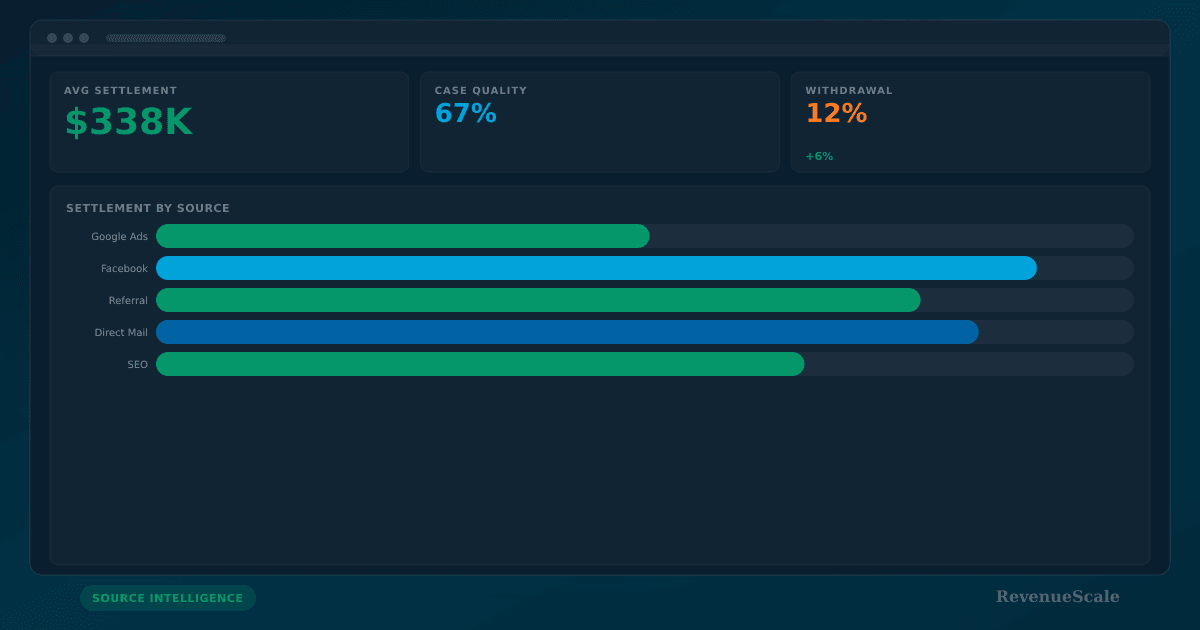
You know which vendors sent leads last month. You probably know which ones produced signed cases. But do you know which ones produced cases that actually settled — and for how much? If not, you're optimizing your budget using roughly 30% of the picture.
Tracking settlement outcomes by lead source is the difference between cost per lead and cost per resolved case. One tells you what you paid for attention. The other tells you what you paid for revenue. This guide walks through exactly how to build that connection — step by step.
Why Settlement Tracking Changes Everything
Two vendors, both sending leads at $80 each. Vendor A produces cases that settle at an average of $90,000. Vendor B produces cases that settle at $225,000. Without settlement tracking, these vendors look identical in your reports. With it, Vendor B is generating 2.5x more revenue per marketing dollar.
That gap compounds fast. If you're allocating $300,000 per month across five or more sources, a 15–20% budget shift toward higher-settlement-value vendors can add $400,000 to $900,000 in annual revenue — without increasing total spend.
The Core Challenge: The 12–18 Month Lag
Keep reading
PI cases don't settle in 30 days. The average personal injury case takes 12 to 18 months from signed retainer to settlement. Surgical cases, multi-vehicle accidents, and premises liability disputes often run 24 months or longer.
That lag is the core problem: the marketing spend that generated a case happened over a year ago. Your vendor mix, spend levels, and campaign strategy may look nothing like they did when that lead walked in the door.
The solution is a cohort-based approach — group leads by the month and source they came from, then track each cohort through to resolution. The timeline varies; the attribution method holds.
Step-by-Step: Building Your Settlement Tracking Workflow
This is the exact workflow for connecting settlement outcomes back to originating lead sources. Each step builds on the previous one — skip one and the downstream data breaks.
Tag Every Lead at Point of Entry
Every inbound lead needs a source tag: vendor name, campaign identifier, and entry date. That tag must survive the entire case lifecycle. If it disappears during intake handoff or a CMS migration, the attribution chain breaks. Use a dedicated, protected source field — not free-text notes that get overwritten.
Connect Lead Records to Case Records
When a lead converts to a signed case, the source tag must carry over. LeadDocket does this automatically through its native integration. Other systems require a consistent field-mapping process — either automated or a manual protocol intake follows for every conversion, without exception.
Establish Monthly Lead Cohorts
Group all leads by origination month and source. January 2025 leads from Vendor A become one cohort. Track this cohort as a unit: how many converted to signed cases, how many are still active, and eventually how many settled and at what value.
Track Case Status Through Resolution
Every status change matters — signed, in litigation, settled, dismissed, referred out. Your CMS should capture the date and nature of each change. When a case resolves, record the settlement amount, resolution date, and case type, all tied back to the original source tag.
Calculate Cohort-Level Settlement Metrics
For each cohort: total settlement revenue, average settlement value, median settlement value, settlement rate (cases settled vs. cases signed), and median time-to-settle. Compare these across sources to see which vendors consistently produce cases that resolve favorably.
Attribute Revenue Back to Marketing Spend
Match each cohort's settlement revenue to the spend that generated it. Spent $55,000 with Vendor A in January 2025 and those leads produced $660,000 in settlements? That's a 12:1 return. That number drives budget decisions — not the cost-per-lead figure your vendor sends every month.
Data Requirements: What You Need in Place
Settlement tracking by source requires four things in your data infrastructure. All four. Missing any one of them breaks the chain.
- Persistent source tagging.A lead source field that survives the full journey from lead to case to settlement. Not a notes field. Not a custom field that gets cleared during intake. A dedicated, protected field that nobody can accidentally overwrite.
- Lead-to-case linkage.A reliable connection between the lead record and the case record. If your intake system and CMS are separate, you need a matching key — phone number, email address, or unique lead ID — to stitch them together.
- Structured settlement capture.When a case resolves, the settlement amount, resolution date, and resolution type must go into a structured data field. If your attorneys log settlements in document notes, you cannot run this analysis at scale.
- Monthly spend records by vendor.What you paid each source, each month. These must use the same vendor naming convention as your lead source tags — otherwise automated matching fails.
CMS Integration: Making It Work With Your Systems
The technical setup depends on your case management stack. Here is what matters for the three most common configurations:
LeadDocket + CMS Integration
LeadDocket captures source data at intake and passes it downstream to Filevine, Clio, MyCase, and similar platforms. If you're using LeadDocket, source tagging is largely solved — the priority is confirming the tag actually carries through to the CMS where settlement data lives. RevenueScaleconnects these systems natively, removing the manual matching step entirely.
Single-System Firms
If your CMS handles both intake and case management (Filevine, Litify, or similar), the data lives in one place. Your only challenge is consistency: intake staff must tag the lead source field at case creation, every time. Make it a required field — not optional, not “fill in later.” Optional means missing.
Spreadsheet-Based Tracking
A spreadsheet can work at low volume — under 50 new leads per month. Beyond that, manual matching becomes unreliable. At 100+ leads per month, error rates on manual attribution typically exceed 15%. That means roughly one in six cases is attributed to the wrong source. Your settlement data looks clean; your decisions are based on noise.
The Cohort-Based Approach in Practice
A concrete example shows how cohort tracking plays out over time.
In March 2025, Vendor C sends 120 leads at a total cost of $18,000. Intake converts 8 into signed cases. Those 8 cases enter the pipeline.
Here is what happens to the March 2025 / Vendor C cohort over the next 18 months:
- 2 cases settle by month 9 — average settlement $95,000
- 3 cases settle by month 15 — average settlement $145,000
- 1 case settles by month 18 — settlement $320,000
- 1 case is dismissed at month 12
- 1 case remains in litigation at month 18
Total: $920,000 in settlements from $18,000 in spend — a 51:1 return on marketing investment. That number exists only because the cohort was tracked from origination through resolution. Without it, Vendor C looks like any other source in your cost-per-lead report.
Common Mistakes That Break Settlement Attribution
Firms that attempt settlement tracking often make errors that quietly invalidate the data:
- Overwriting source tags.A lead clicks a Google ad, then calls back two weeks later from a TV spot. The original source gets overwritten. Default to first-touch attribution — credit the source that initiated the relationship, not the last touchpoint before conversion.
- Inconsistent vendor naming.“Mass Tort Leads LLC” in your intake system and “MassTort” in your CMS means automated matching fails silently. Standardize vendor names across every system and enforce the convention at onboarding.
- Ignoring dismissed cases.A vendor with a 40% dismissal rate is fundamentally different from one at 10% — even if the settled cases look similar on paper. Track dismissals and attrition alongside settlements, not just the wins.
- Snapshot analysis instead of cohort tracking.Comparing “settlements this month” to “leads this month” is a category error. This month's settlements came from leads 12–18 months ago. Cohort analysis is the only method that accurately connects cause to effect.
What to Do With the Data Once You Have It
Settlement attribution unlocks three decisions that cost-per-lead data simply cannot support:
- Vendor portfolio optimization.Shift budget toward vendors whose leads produce higher settlement values — not just higher conversion rates. A vendor at 5% conversion with $210,000 average settlements is more valuable than one at 10% conversion with $55,000 average settlements. The math is unambiguous once you can see it.
- Case type targeting.If auto accident leads settle at an average of $125,000 and slip-and-fall leads at $70,000, you have a data-driven basis to adjust your vendor mix and campaign targeting toward higher-value case types.
- Partner reporting with revenue data.Instead of telling partners “we signed 45 cases this month,” you show them: “our Q1 2025 marketing cohort has produced $3.1M in settlements to date, with an estimated $1.4M still in pipeline.” That is a different conversation — one your partners cannot argue with.
Getting Started
If you are not currently tracking settlement outcomes by lead source, start manually with your most recent closed cases. Pull the last 50 settled cases and trace each one back to its originating lead source. Do it once, by hand. The patterns that surface — which vendors appeared repeatedly, which case types dominated, which months over- or under-performed — will make the case for building a systematic process better than any pitch deck could.
For firms ready to automate, RevenueScale's case analytics connects your intake system to your CMS and tracks every lead cohort through to settlement without manual matching. The data flows from lead to resolution automatically — no spreadsheets, no broken attribution chains, no one-in-six cases misattributed.
Firms that track settlement outcomes by source make better budget decisions, negotiate from a position of strength with vendors, and report marketing ROI in terms partners actually respond to: revenue generated per dollar spent. That is the metric that matters — and it starts with connecting the settlement back to the source.
Related guide: See our complete guide to tracking marketing ROI for PI law firms — the PI-specific ROI formula, 5 prerequisite metrics, and how to present results to managing partners.
Related guide: See our complete guide to lead source tracking for law firms — the 4-level attribution chain, 8 data points, and 5-step tracking system every PI firm needs.
Related guide:For a full breakdown of every PI lead vendor, see our guide to Personal Injury Lead Vendors — a category-by-category review of who delivers signed cases, who burns budget, and how to negotiate better contracts.